

Bacteria, transitional epithelial cells, and white blood cells in urine sediment
Bacteria, transitional epithelial cells, and white blood cells in urine sediment
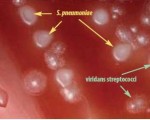
Streptococcus pneumoniae colonies
Streptococcus pneumoniae colonies have a flattened and depressed center after 24-48 hours of growth on Blood Agar, whereas the viridans streptococci retain a raised center

Bacteria, Mucus and White Blood cells in Urine Sediment
There are white blood cells, bacteria and mucus present.The number of white blood cells could suggest the presence of a urinary tract infection.
If the white blood cells were not present,the ...
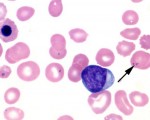
Pappenheimer bodies VS Howell-Jolly bodies Differentiation
These inclusions are blue-purple in color, irregular in shape and located on the periphery of the cell. They were are Pappenheimer bodies. some people may think these inclusions ...

Howell and Jolly Body from Hair Cell Leukemia Patient
This arrow points to Howell and Jolly body, this blood smear has been taken from 86 old female patient presented with fatigue and abdominal pain, with increased white blood cell ...

Oxalate and Uric Acid Crystals in Acidic Urine
Left is Oxalate Crystals , Right is Uric Acid Crystals
Note the PH of the Urine sample was 6

Glitter Cells in Hypotonic Urine
in hypotonic urine usually below < 1.005, the granules in vital white blood cell shows Brownian movements, these cells usually seen in Urinary Tract Infections, these cells called ...
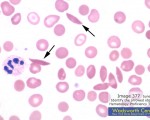
sickle cell anemia and drepanocytes on smear
a 30 year-old female diagnosed with sickle cell anemia. “Sickle cell anemia (Hb SS disease) is caused by inheritance of two ßs genes and is the most serious of the sickling syndromes. ...

Sufla Crystals that resemble Uric Acid Crystals
Sulfa crystals from the urinary sediment of a patient taking (sulfamethoxazol), These crystals resemble crystals of uric acid or calcium oxalate, but sulfa crystals are soluble in acetone
Sulfa ...

red and white blood cells, and yeast in urine sediment
The cells shown in this field are red blood cells, white blood cells, and yeast

Infectious mononucleosis and atypical lymphocytosis on a smear
Infectious mononucleosis is an infection usually caused by the Epstein-Barr virus. The virus spreads through saliva, which is why it’s sometimes called “kissing disease.” ...


