
Featured Articles
 11 years ago
White blood cells: Description, Classification and Formation
 11 years ago
Blood Cells and Platelets
 11 years ago
Gram stain of wound specimen
All Stories

Bacteria in urine sediments
Bacteria can be identified in unstained urine sediments when present in sufficient numbers by their characteristic rod shapes. This is more readily done for bacilli than cocci, which ...
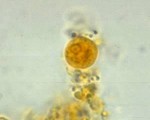
Cyst of an E. hartmanni
Cysts of Entamoeba hartmanni are similar to those of E. histolytica but smaller, measuring 5-10 µm.
Mature cysts contain four nuclei that possess a small, discrete centrally-located ...

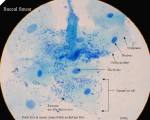

E. Gingivalis trophozoite
E. Gingivalis trophozoite, Trichrome-stained.
Looks like Entamoeba histolytica.
Ingested leukocytes in cytoplasm is its distinct character.

Tetrad Arrangement
Tetrad Arrangement (Gram Stain) of Micrococcus roseus grows in squared packets of cells, evident even when they are bunched together.
The normal habitat for Micrococcus species is ...

pollen grain
a pollen grain , Don’t mix it with A.lumbricoides’s ovas
Round grains with heavy walls. The grain has short blunt spikes, shaped like equal-sided triangles.

hypochromic microcytic anemia
Note the larger zones of central pallor in these small RBCs, along with poikilocytosis. The most common cause for a hypochromic microcytic anemia is iron deficiency. The most common ...

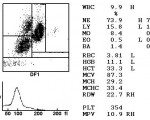
CBC of microangiopathic hemolytic anemia
The CBC of a patient with microangiopathic hemolytic anemia (MAHA) demonstrates a markedly increased RDW (red cell distribution width) due to the marked variation in size and shape ...

H-hemoglobin disease
H-hemoglobin disease
————————––
An inclusion body positive cell seen in Brilliant Cresyl Blue stained red cells of a α0-thalassaemia ...

Fungemia
Fungemia is the presence of fungi or yeasts in the blood. The most common type, known as Candidemia which caused by Candida species.
It is most commonly seen in immunosuppressed or ...


